- Klaviyo
- GA4
- Attribution
- Ecommerce Tracking
Why Klaviyo Revenue Doesn't Match GA4 or Shopify
By Dolphin Analytics team · Published 28 Aug 2026 · Updated 1 Sept 2026
TL;DR
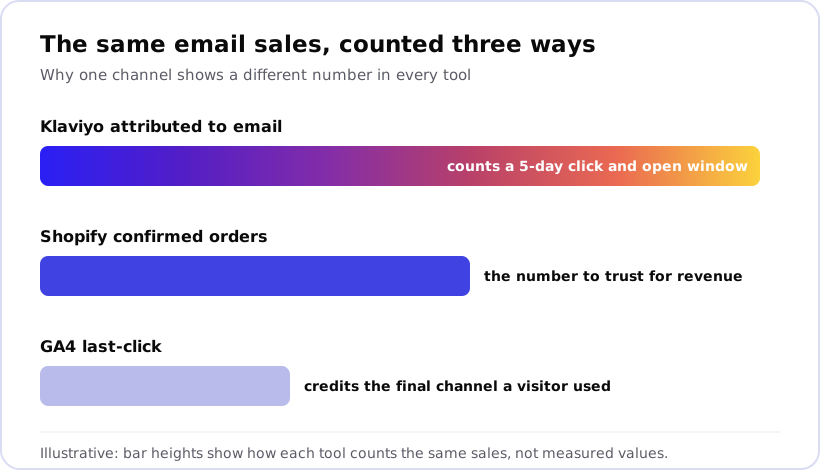
Klaviyo credits email with more revenue than GA4 or Shopify because it counts any order placed inside its attribution window, five days after a click by default, while GA4 credits the last click and Shopify counts only completed orders. Klaviyo overcounts, GA4 undercounts, and Shopify is the number to trust for revenue. Reconcile the three before you decide email budget; We do this reconciliation for clients most weeks.
Olamide Sule, founder of Dolphin Analytics: a digital analytics expert based in London who reconciles attribution across Klaviyo, GA4 and Shopify for agencies and ecommerce teams.
Your Klaviyo dashboard says email drove a small fortune last month. GA4 credits email a fraction of it. Shopify, the till that actually took the money, sits somewhere in between. Three tools, one set of sales, three different answers. Before you reduce or defend email budget on those numbers, it helps to know why they disagree and which one to run the business on. We reconcile these three systems for clients most weeks; this is how we do it.
Why is Klaviyo revenue higher than GA4 and Shopify?
Klaviyo reports more email revenue than GA4 or Shopify because of how each tool counts a sale. Klaviyo credits email whenever a recipient clicked, and often opened, inside its attribution window, then counts the full order value. GA4 credits the last non-direct channel of the session, and Shopify counts only orders that completed at checkout. Same orders, three counting rules, three totals.
The gap is not a bug in any of the three. It is three tools answering three different questions. Klaviyo answers “which email did this shopper touch before buying.” GA4 answers “what was the last thing that brought this session in.” Shopify answers “how much money came through the checkout.” Once you see them that way, the disagreement stops looking like a data error and starts looking like a translation problem.
What is the Klaviyo attribution window?
The Klaviyo attribution window is the period after someone clicks or opens a message during which Klaviyo will credit that message with any order they place. By default it runs five days from a click for email, with SMS on a shorter window, and it can include open-based attribution depending on your account settings (Klaviyo’s own documentation sets this out). Widen the window and email’s reported revenue climbs, because more of every shopper’s later purchases fall inside it.
That default is generous on purpose. A five-day click window means a shopper who opens your Tuesday campaign, clicks through, then comes back on Saturday through a Google search and buys, still shows as an email sale in Klaviyo. The email did play a part. It just was not the only, or the last, thing that moved them. You can tighten the window or switch the model in Klaviyo’s settings, and it is worth testing a shorter one to see how much of your email revenue depends on the long tail of the window.
How does GA4 count email differently?
GA4 counts the same email sale with the opposite bias. Its standard acquisition reports credit the last non-direct source of a session, and its conversion reports default to a data-driven model, so an email click that is not the final touch usually loses the sale to whatever channel closed it (Google’s attribution documentation explains the models). Where Klaviyo reaches back five days and claims the order, GA4 looks at the last step and often hands it to organic search, direct or paid.
Two more things drag GA4’s email number down. First, an email click only shows as email traffic in GA4 if the Klaviyo link carries UTM tags; untagged links land in direct or unassigned, invisible as email. Second, GA4 measures browser sessions, so consent banners, ad blockers and dropped events erase a slice of every channel before it is even attributed. Put those together and GA4 is structurally the lowest email number of the three.
Why is Shopify the number to trust for revenue?
Shopify is the reliable figure for how much money email helped bring in because it records every completed order on its own servers, independent of the shopper’s browser. It does not model, sample or attribute across a window; it counts the sale when the payment clears. That makes it the denominator every other tool should be measured against, even though Shopify alone will not tell you which channel earned the order.
GA4 almost always shows fewer sales than Shopify. A gap of roughly 10 to 15% between Shopify and GA4 purchases is normal; beyond that is worth investigating. Consent-blocked sessions and the odd dropped checkout event explain most of it. We walk through that specific mismatch in Shopify analytics versus GA4. The point for email budgeting: Shopify sets the size of the pie, then Klaviyo and GA4 argue over how big email’s slice of it really is.
What an overcount looks like on a real account
Attribution windows do not just shift credit; they inflate it. On one subscription box brand we audited, the clearest overcount was on paid ads rather than email, driven by view-through purchases where shoppers saw an ad and never clicked. Klaviyo’s window works on the same principle, crediting sales a message touched rather than sales it closed. We pull that paid example apart in why Meta reports more sales than actually happened.
Here is the part that keeps the story honest: on that same account, email was genuinely the strongest channel, well ahead of any other on the store. Here is what stripping the view-through inflation out of paid showed. For a subscription retailer, the real return was 4.7x, against a dashboard claiming 32.8x. The fix was never to dismiss the email or the ad numbers. It was to anchor every channel to Shopify’s confirmed orders, then let each platform explain its own credit against that shared total. An inflated number does not mean a weak channel; it means a channel measured too generously.
How to reconcile Klaviyo, GA4 and Shopify
Reconciling the three is a repeatable process, not a one-off guess. Line the tools up against Shopify and the disagreement becomes readable:
- Fix the date range and time zone first. Klaviyo, GA4 and Shopify can all sit in different time zones. Match them before you compare anything, or you will chase a gap that is really a clock.
- Tag every Klaviyo link with UTMs. Without them, email clicks land in direct or unassigned in GA4 and vanish from the email total. This is the single most common reason GA4 shows almost no email revenue.
- Take Shopify’s order revenue as the truth. That is the real money for the period. Everything else is a claim about who caused it.
- Read Klaviyo as the ceiling and GA4 as the floor. Email’s true contribution sits between the window-inflated Klaviyo figure and the last-click GA4 figure, closer to whichever your other evidence supports.
- Shorten the Klaviyo window as a test. Rerun the same period on a tighter window to see how much of email’s revenue depends on the long tail of the five-day default.
Do that once and you stop asking “which tool is lying” and start asking the useful question: given that email genuinely influences sales, how much of the credit holds up when you measure it against the money that actually landed?
Get the real email number before you set budget
If your Klaviyo, GA4 and Shopify numbers are pulling in three directions and you need one you can put in front of a client or a board, that reconciliation is exactly what our free data audit is built to sort out. Tell us what is disagreeing, and we come back with the reconciled picture: what email is really worth, which tool to trust for what, and where the tracking is quietly losing sales. It is the same source-of-truth work we run across GA4, Shopify, Klaviyo and the ad platforms every week.
Frequently asked
Why is Klaviyo revenue higher than GA4?
Klaviyo credits email with a sale whenever a recipient clicked, and often opened, inside its attribution window, five days by default, even if the shopper later returned through Google or typed the URL directly. GA4 credits the last non-direct channel of the session instead, so it hands most of those sales to whatever touch came last. The same order counts as email in Klaviyo and as something else in GA4, so Klaviyo always reports the higher email figure.
What is Klaviyo's default attribution window?
Klaviyo's default conversion attribution window for email is five days from a click, with SMS set to a shorter window, and it can also credit opens depending on your settings. Any order a recipient places inside that window is attributed to the message. You can change the window and the model in your account, but the wider it is, the more revenue Klaviyo claims for email.
Which is right, Klaviyo or GA4?
Neither is the full truth on its own. Klaviyo overcounts because its window catches sales other channels also influenced; GA4 undercounts because it credits only the last click and loses orders to consent banners and ad blockers. Use Shopify for how much revenue actually landed, then use Klaviyo and GA4 to argue about who gets the credit.
Should I trust Klaviyo's revenue numbers for budget decisions?
Trust the direction, not the absolute figure. Klaviyo is usually right that email is a strong channel, but its attribution window inflates the revenue number, so budgeting straight off the dashboard overstates email's true contribution. Anchor the decision to Shopify's confirmed orders and treat Klaviyo's number as the ceiling, not the answer.
How do I reconcile Klaviyo, GA4 and Shopify?
Start from Shopify as the source of truth for revenue, tag every Klaviyo link with UTMs so GA4 can see the traffic, then compare the same date range and time zone across all three. Expect Klaviyo highest, GA4 lowest, Shopify in between. The reconciled email number sits below the Klaviyo figure and above the GA4 one.